TesboFlow
Days of CFD.Done before lunch.
The whole pipeline lives on the GPU. Nothing waits on the CPU.
100 million cells. One step. One second.
Measured: 110.6M cells · 8×A100 · 1.5 s/step
0×
vs one CPU core
0×
vs 18 CPU cores
Products
Four products. One CFD loop.
Two GPU solvers, a mesher that writes TesboFlow-native mesh, and AI in the same pipeline.
TesboFlow · Measured
Performance
Already this fast. On this hardware. On these meshes.
- 0×
- vs one CPU core
- 0×
- vs 18 CPU cores
- 0.0 s
- 110 million cells, one step
The suite target remains 1,000×, a ten-minute typical run, and 1 → N GPUs in one build.
Measured · TesboFlow, September 2026
Wall time per step
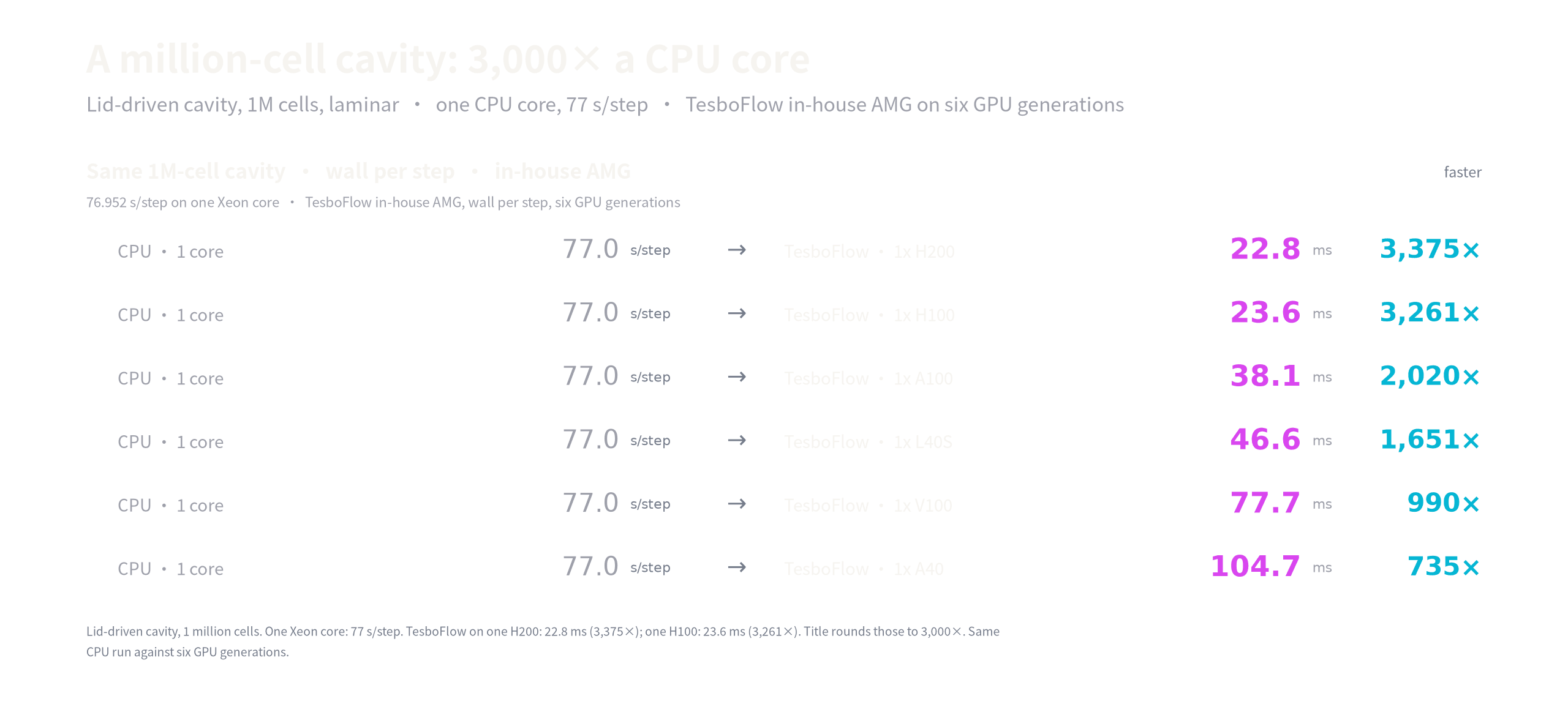
1M-cell lid-driven cavity, laminar — one CPU core against one GPU
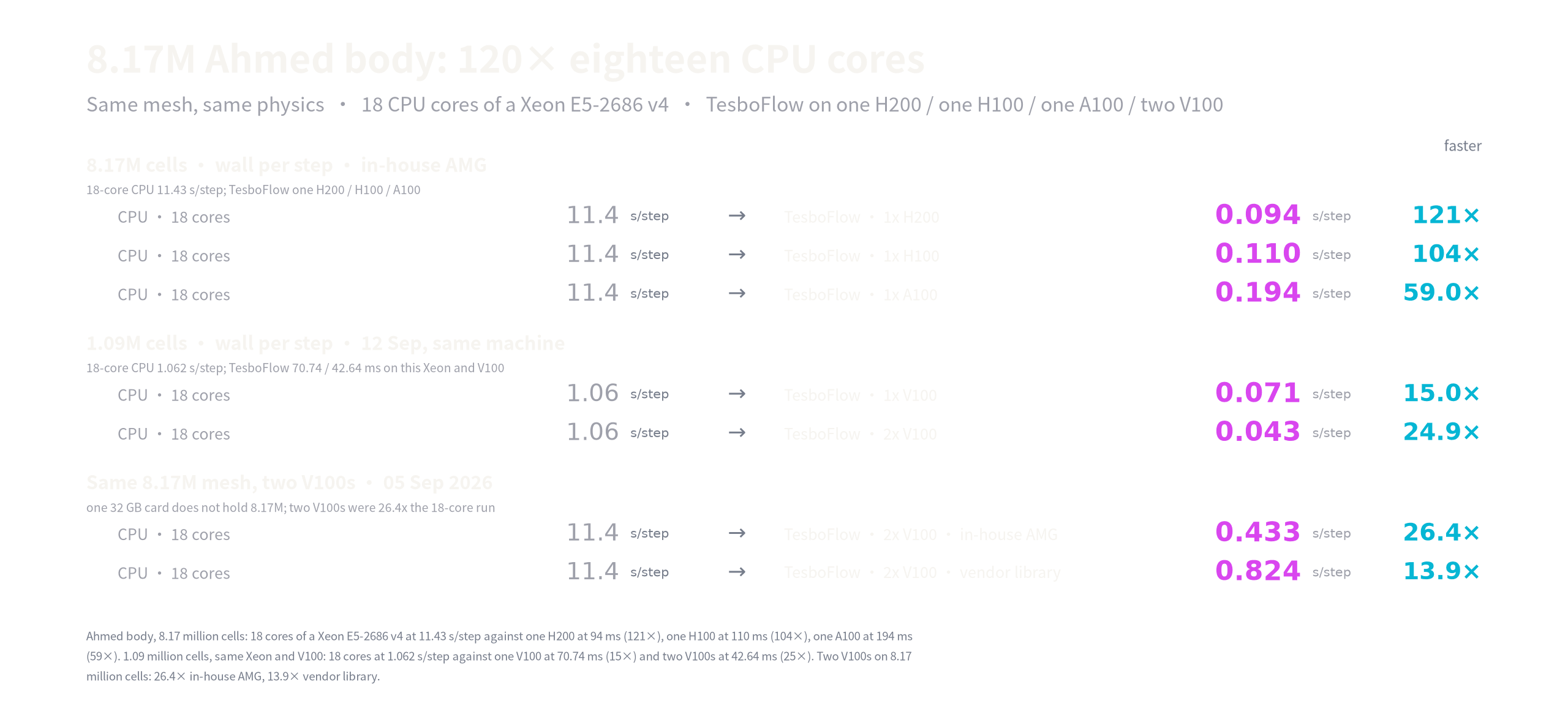
8.17M Ahmed body, steady RANS — eighteen CPU cores against one GPU
100 million cells. One step. One second.
110.6 million cells · 8× A100 · 1.5 s/step
Measured: 1.5 s/step.
Typical scenes, not a contract. 3,000×: 1M-cell cavity, one CPU core, one H200 at 22.8 ms. 100×: 8.17M Ahmed body, 18 Xeon cores, one H200 at 94 ms. 110.6 million cells on 8×A100 at 1.5 s/step.
TESBOLBM · MEASURED
Casting simulation, at GPU speed
- 0×
Against one CPU core
1851 MLUPS on a single Tesla V100 against 4.1 MLUPS on one core of the same machine.
- 0×
Against the whole CPU node
The same GPU run against all 18 cores of that machine under MPI, at 33.9 MLUPS. This is the figure we quote.
- 0.0×
On the heat conduction kernel
5422 MLUPS against 134 MLUPS on 36 CPU threads, both sides running the same arithmetic.
One machine, one Tesla V100, same kernel on both sides — nothing scaled or extrapolated. The node figure is far below the single-core ratio because the CPU itself only gains 8.3× across its 18 cores: lattice Boltzmann is bound by memory bandwidth, not clock speed.
Compute Faster
GPU-Native Architecture
TesboFlow runs the entire CFD pipeline on GPU — mesh, solver, linear algebra, post-processing. No CPU bottleneck. No data transfer overhead. Pure parallel computation.
- No CPU bottleneck
- Massive parallelism
- High memory bandwidth
The same GPU-native approach carries TesboLBM: mould filling and solidification also run start to finish on the GPU.
Explore TesboFlowWhy TesboFlow
Not a port. A GPU-native finite-volume solver that is already this fast, on this hardware, on these meshes.
In-house AMG
Faster and leaner than NVIDIA AmgX. A thousand iterations in 35 s and 7 J, against 59 s and 11 J.
Add cards. Wall-clock still drops.
Meshes that do not fit one GPU still get cheaper when you add more. 56 million cells, and the extra cards pay.
Ahmed body · turbulent wake · computed on GPU
Real-time Navier-Stokes Wind Tunnel
Test fluid mechanics in real time directly in your browser. Choose a preset airfoil, a cylindrical vortex-shedding obstacle, or draw custom solid boundaries with your finger to watch vorticity and pressure waves evolve.
TesboAI · AI + CFD research
Intelligence, native to the solver.
Because the engine is GPU-native, models train on its data and run in its memory. Here's a result, not a promise.
you
TesboAI
relative L2 error 0.194 · tolerance 0.25
A session replayed — asking, changing conditions, comparing runs; every figure computed by the GPU solver.
Research prototype, in development. A short replay of one real session — the full session is on the TesboAI page.
The GPU era of simulation
Built for speed. Powered by GPU.
Speed isn't a feature — it's what makes simulation usable. When an answer takes minutes instead of days, engineers stop waiting and start exploring. We build for the GPU from the ground up to make that the default.
This will change the world.
— Tesbo, Project Founder
Start Using TesboFlow
Experience GPU-native CFD simulation with TesboFlow.
About TesboCFD
TesboCFD develops next-generation GPU-native CFD technologies for engineering simulation and AI-assisted design.

Tesbo
Research Collaborations & Solver Validation