TesboCFD
What TesboFlow is checked against
Exact solutions, published benchmarks and an independent CPU solver. What TesboFlow is compared with, and what a pass does and does not tell you.
Speed only counts when the answer is right. So TesboFlow is checked against a fixed list of cases, and every case is compared with a reference from outside the code.
Three kinds of reference
They answer different questions, so we keep them apart.
Exact solutions. The computed field against a closed-form solution of the same equations on the same geometry. A pass means the discretisation and the solver solve the equations they claim to solve.
Published benchmarks. A profile or an integral quantity against archived experiments and reference codes, from Ghia, Ghia & Shin 1982 to the NASA Turbulence Modeling Resource. A pass means the whole chain, from mesh and turbulence model to wall treatment and scheme, reproduces a result the field agrees on.
An independent solver. The full field against an independent CPU solver on the same mesh, model and boundary conditions. A pass means two independently written codes agree.
What a pass tells you, and what it does not
Two codes that agree can both be off from the experiment. If both miss the wind tunnel by the same amount, the gap comes from the model they share, not from either code. So a pass against the independent solver shows agreement. Physical accuracy is what the exact solutions and the published benchmarks carry.
A case run on one mesh at one Reynolds number tells you about that mesh and that Reynolds number, and nothing more.
A few of the cases
The Ghia cavity
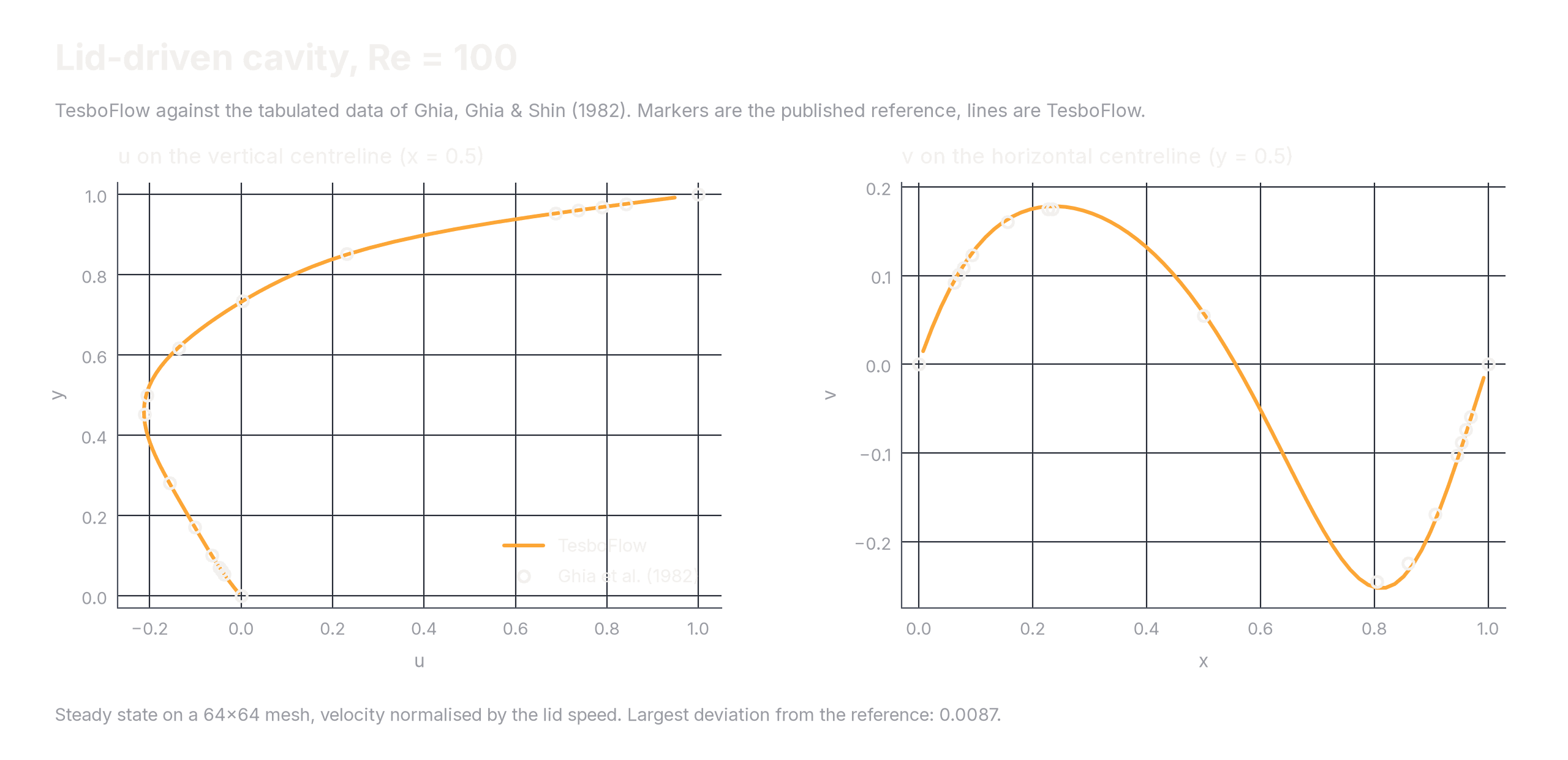
The lid-driven cavity at Reynolds 100 is a benchmark every CFD code is expected to reproduce. The reference is Ghia, Ghia & Shin, 1982. The check is the centreline velocity, u along the vertical centreline and v along the horizontal one, at the 17 stations Ghia tabulated.
The Sod shock tube
Sod's problem has an exact solution, so no reference run is needed. The computed profile is judged on where the shock and the contact discontinuity sit, the plateau values of density, velocity and pressure between them, the rarefaction fan, and the profile as a whole. The same tube also runs with the Barth–Jespersen limiter and with the Venkatakrishnan limiter, each judged against the exact solution. And the field is compared with an independent CPU solver on the same mesh, model and boundary conditions.
NACA 0012 lift against CFL3D
The NASA Turbulence Modeling Resource publishes reference results for checking turbulence models. For the NACA 0012 at 10° angle of attack, Mach 0.15 and a chord Reynolds number of 6 million, with Spalart–Allmaras, NASA's CFL3D gives a lift coefficient of 1.0909. FUN3D, listed alongside it, gives 1.0983. TesboFlow runs the same case with its density-based solver, and its lift coefficient is checked against the CFL3D value.
A cold plate, judged by a detection matrix
An interposer cold plate: seven solids in four materials plus the coolant, coupled by conjugate heat transfer and compared with an independent CPU solver on the same mesh, model and boundary conditions. One tolerance would tell you whether the fields are close. It would not tell you whether a real mistake would break the check.
So the case is judged by a detection matrix. The check is built around two small defects, one in the conductivity of the thermal interface and one in the coolant flow rate, and they show up in different quantities. Every band is set well above the run-to-run variation and well below the signal of the defect it exists to catch. A quantity that cannot meet both conditions is reported, and is not used as a check.
Why the droplet band is wide
A static droplet held by surface tension alone should show the Laplace pressure jump σ/R, with nothing moving. No VOF code gets there exactly. A piecewise-constant interface produces spurious currents in every code, and the independent solver misses the jump by a wide margin on this case too.
A band that a correct field would fail is not used, so the band sits above that shared error. The case does not grade the curvature estimate every code shares. It catches a broken surface-tension term, which is what it is there for.
How the bands are set
Every band is set from the discretisation error of the mesh the case runs on, so a correct field passes. A few long benchmark runs, such as the Ahmed body, are run on request, and the list says which.
The full list
Every case, grouped by application area, with what it is compared with and what is judged, is in the docs: verification and validation.
Check it on your own case
The benchmark that matters most is yours. Send us a case you have already run: any physics we sell. We send back accuracy on the quantities you name, wall-clock time and memory.