文章目前只有英文版。
TesboCFD
Three numbers, and the hardware behind them
3,000× a CPU core, 100× eighteen cores, 100 million cells at 1.5 s a step. What each number measures, on which machine, and how to check it on your own case.
Every CFD vendor has a speedup slide. Ours comes with the case, the mesh and the card.
The TesboFlow page leads with three numbers. This post takes them one at a time: what was solved, how big the mesh was, what it ran on, and what it was compared against. Everything here is on the TesboFlow performance section already. This is the long version.
3,000× one CPU core
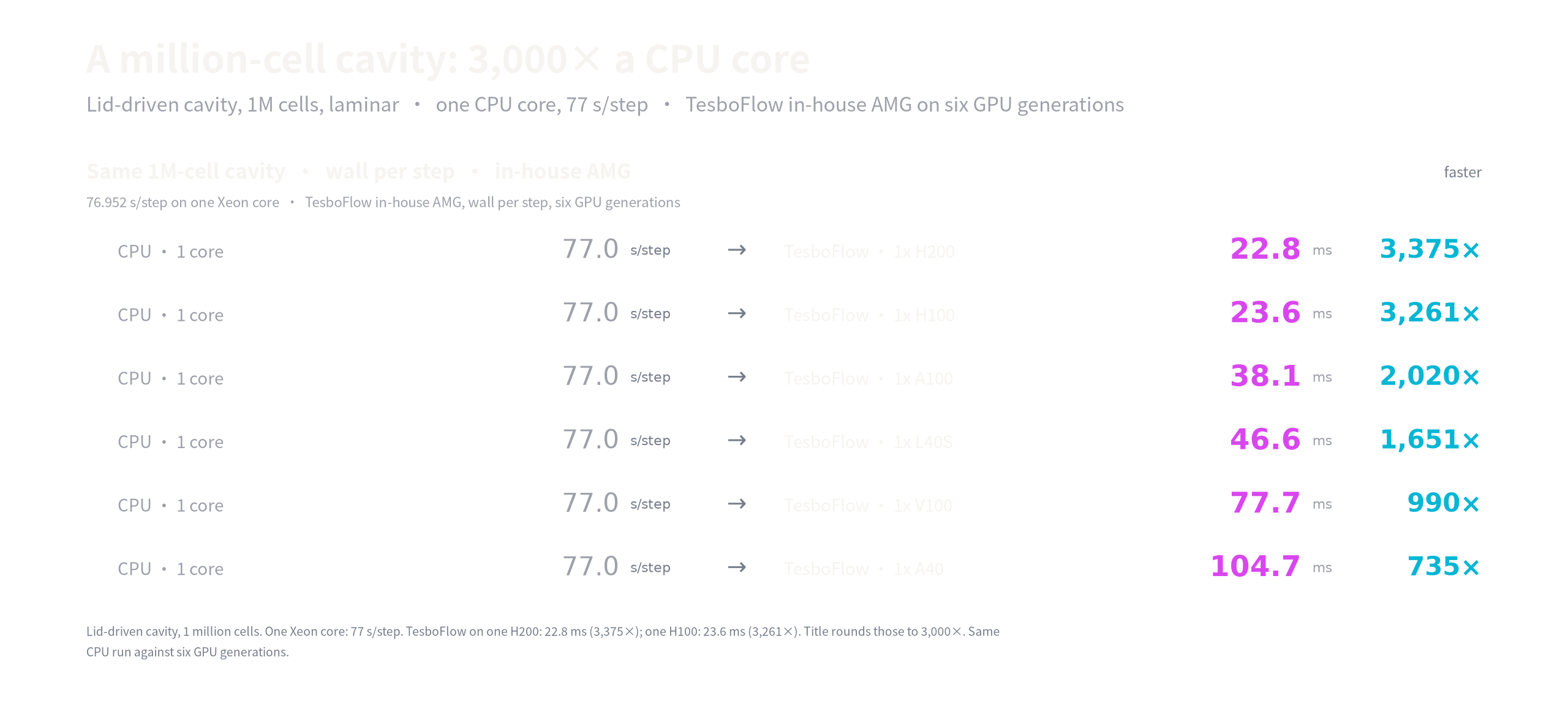
Case: lid-driven cavity, laminar, one million cells. Reference: one CPU core, 77 seconds a step. TesboFlow: one H200, 22.8 milliseconds a step.
One core is the cleanest baseline there is. Nobody has to argue about how well the CPU code scales, how the domain was split, or how busy the node was. One core, one card, the same case.
The same cavity runs on six GPU generations, from V100 to H200, with no change to the solver. Even the oldest card on the chart is hundreds of times faster than the core.
100× eighteen CPU cores
Case: Ahmed body 25°, steady RANS, 8.17 million cells. Reference: eighteen CPU cores, 11.4 seconds a step. TesboFlow: one H200, 94 milliseconds a step.
This is the comparison a team with a workstation cares about: a full multi-core CPU run against one card in the same box. A step that took eleven seconds takes less than a tenth of one.
100 million cells, one step, one second
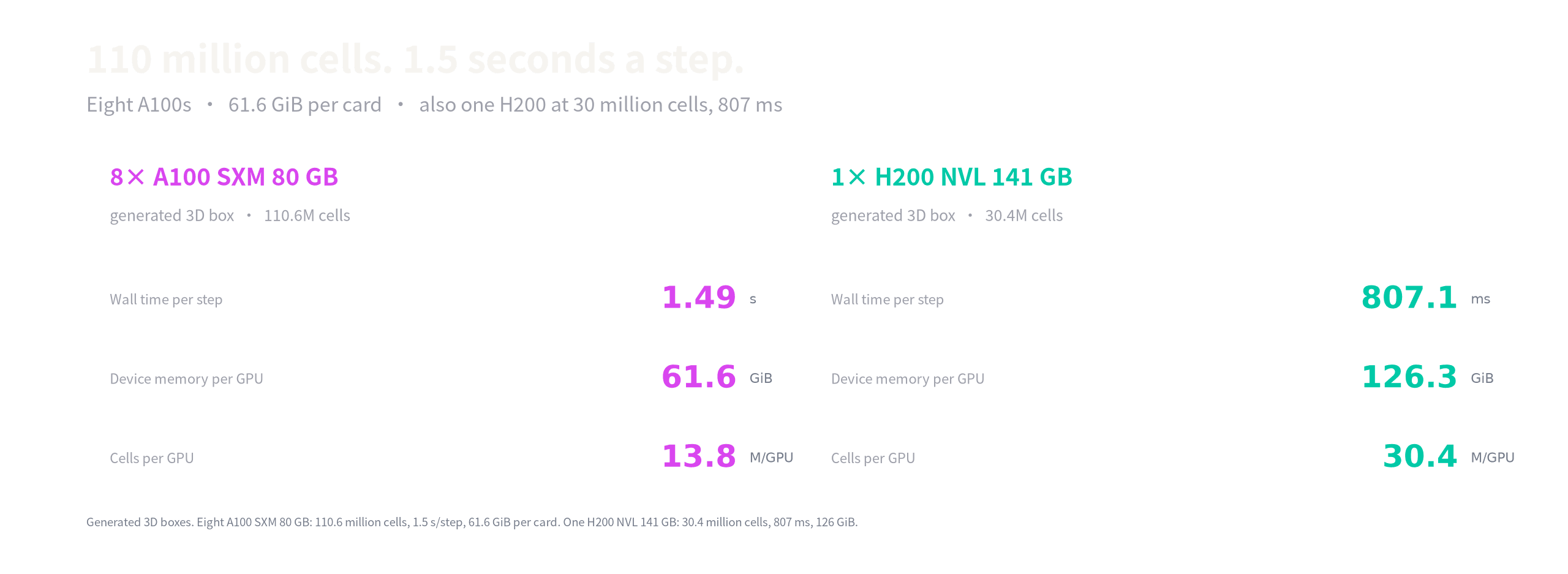
Case: a generated 3-D box, 110.6 million cells. TesboFlow: eight A100 80 GB cards, 1.5 seconds a step, 61.6 GiB per card.
A mesh this size does not fit on one GPU, so the case is split across eight. It is the same solver and the same build that runs the cavity on one card. On one H200, TesboFlow holds 30.4 million cells in 126 GiB at 807 milliseconds a step.
The solver underneath
Most of a pressure-based CFD step goes into the linear solve, so that is where we started. TesboFlow uses its own GPU algebraic multigrid. On the Ahmed body, one A100, one thousand iterations: 35 seconds and 7 J for our AMG, against 59 seconds and 11 J for NVIDIA AmgX.
The whole pipeline stays on the GPU. There is no copy back to the CPU every iteration, and that is where the speed comes from.
Fast, and right
A fast wrong answer is worth nothing. The verification section shows the checks:
- The Ghia lid-driven cavity at Reynolds 100 agrees with the published reference to within 0.0087.
- On the Ahmed body at 1.09 million cells, TesboFlow gives a drag coefficient of 0.2964 against 0.297 for a CPU solver on the same mesh.
- One GPU and two GPUs agree on that drag coefficient to 0.02%.
What these numbers are not
They are typical scenes, not a contract. Your mesh, your physics and your hardware decide your number. Against a full CPU cluster, 100–1000× remains a target, not one of these measurements.
Check it on your own case
Send us a case you have already run: any physics we sell. We send back accuracy, wall-clock time and memory. The solver stays with us.